
Understanding your company’s greenhouse gas (GHG) emissions is the first step toward reducing your environmental impact. But before you can cut emissions or report them accurately, you need to identify where they are coming from. At Combatting Carbon, we help businesses map out their emissions sources clearly and efficiently, so every step toward sustainability is based on solid data.
1. Understand the three scopes of emissions
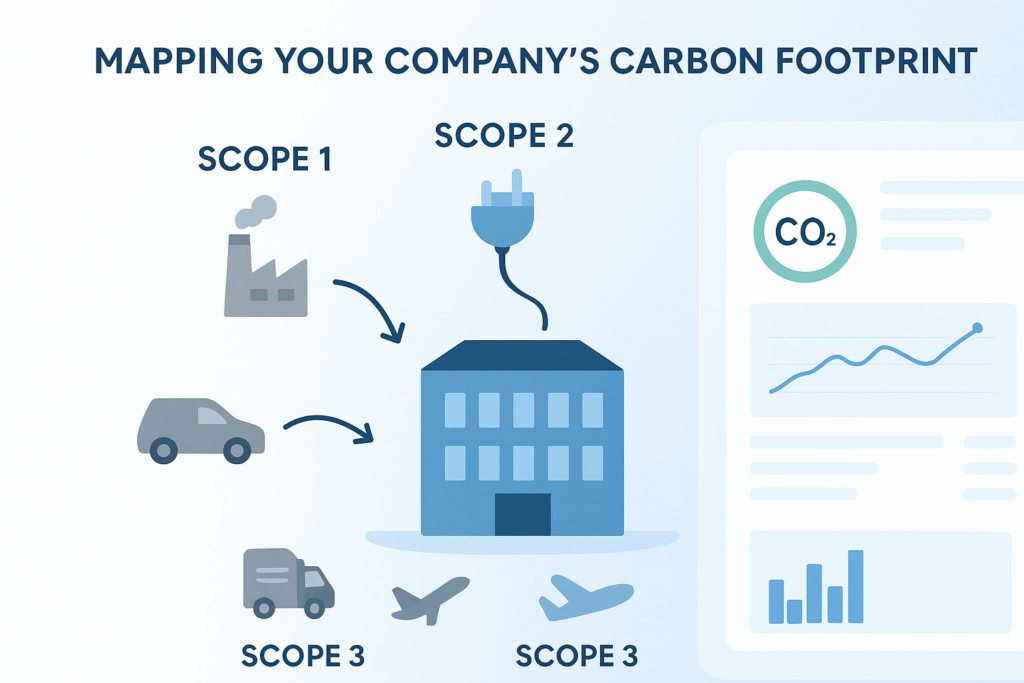
The GHG Protocol, the global standard for carbon accounting, categorizes emissions into three “scopes.” Understanding these scopes is essential for identifying where your emissions originate:
- Scope 1: Direct emissions
These are emissions from sources owned or controlled by your company.- Fuel combustion from owned vehicles or machinery or owned facilities.
- Fugitive emissions from air conditioning or refrigerators.
- Scope 2: Indirect emissions from energy
These emissions come from purchased electricity, heat, or steam that your business consumes. For example:- Electricity used in offices, factories, or warehouses
- Heating or cooling provided by a third-party energy supplier
- Scope 3: Other indirect emissions
This is often the largest and most complex category, covering all other emissions in your value chain. There are 15 scope 3 categories, that fall into upstream and downstream emissions. See our blog on understanding your scope 3 emissions for information on this.
By mapping your operations to these scopes, you can prioritise which areas to measure and reduce first.
2. Review your operational activities
Start by examining your day-to-day business activities. Focus on every activity that uses energy or resources, as these will potentially generate emissions. Documenting these systematically creates a clear emissions map.
For example:
| Energy use | Check electricity, gas and heating bills. |
| Transportation | Track company vehicles, business travel, public transport, and delivery logistics. |
| Procurement | Review your suppliers and the products you buy. |
| Waste | Identify the waste streams generated by your operations. |
3. Collect data from key sources
Reliable carbon reporting depends on accurate data. Sources to consider include (but not limited to):
- Utility bills and fuel receipts.
- Procurement and supplier invoices.
- Travel logs and mileage reports.
- Waste disposal records.
At Combatting Carbon, we guide companies in building simple systems to collect and track this data consistently, reducing errors and making future reporting easier.
4. Engage your team
dentifying emissions is not a one-person job. Engage staff across departments to uncover emissions you might overlook. For example:
- Facilities teams know energy use patterns.
- Procurement teams understand supplier-related emissions.
- Operations teams can identify process-related emissions.
By involving employees, you also build a culture of accountability and awareness around sustainability.
5. Prioritise and focus
Not all emissions are equal. Focus on the most material sources first — the areas where your company has the largest carbon footprint or the most control to reduce emissions. For many SMEs, this might be energy use in offices, key suppliers, or transportation.
6. Use technology to map emissions
At Combatting Carbon, we use our own carbon accounting platform to make emissions mapping simple and accurate. Our platform can:
- Aggregate data from multiple sources in one place
- Apply standard emission factors automatically
- Generate visual maps of emissions hotspots
By using our platform, businesses gain a clear, scalable, and reliable view of their carbon footprint — making it easier to identify reduction opportunities and track progress over time.
7. Final thoughts
Identifying your company’s emissions sources is the foundation of carbon accounting. By understanding the three scopes, reviewing operational activities, collecting accurate data, and prioritising the biggest impact areas, you can create a clear roadmap toward reducing your carbon footprint.
With guidance from Combatting Carbon, even small businesses can turn complex emissions data into actionable insights.
Ready to take control of your company’s emissions and start making measurable environmental impact? Get in touch with us at Combatting Carbon today — we’ll help you map, measure, and manage your carbon footprint with confidence.